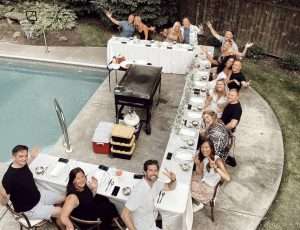
Quick answer: Hibachi catering beats plated dinners, buffets, food trucks, and generic private chefs on one thing they can’t match: live entertainment built into the meal itself. It costs more per head than a buffet but less than a full plated dinner, works well for groups of 10-150, and books in as little as 2-4 weeks.
Choosing a catering format for a corporate event usually comes down to a tradeoff between cost, convenience, and how memorable the event actually feels. This guide compares corporate hibachi catering against the other formats teams typically consider — plated and buffet catering, food trucks, and generic private chef services — so you can pick the right fit for your next team event, office party, or company celebration. If hibachi is the format you land on, the corporate hibachi party page has the headcount tiers, pricing, and booking steps in one place.
How Does Corporate Hibachi Catering Compare to Plated or Buffet Catering?
Plated and buffet catering are built around efficiency — get everyone fed with minimal fuss. Hibachi catering flips that priority: the cooking itself is the entertainment. A private chef grills teppanyaki-style right in front of guests, turning the meal into a shared moment instead of a background task.
- Entertainment Value: Plated and buffet service offer none built in; hibachi delivers a live show with every seating.
- Cost: Buffets are typically the cheapest per head, plated dinners the most expensive, and hibachi lands in between — but includes entertainment a buffet or plated meal would need to pay for separately.
- Guest Experience: Plated service feels formal; buffets feel casual; hibachi feels like an event in its own right.
How Does Hibachi Catering Compare to Food Trucks for Corporate Events?
Food trucks are a popular choice for casual company gatherings, prized for their convenience and low commitment. Hibachi catering trades some of that convenience for a far more interactive experience:
- Setup: Food trucks need parking access and often a permit; hibachi chefs set up a portable grill station wherever your event is happening — office, backyard, or venue.
- Interaction: Food truck lines are transactional; hibachi chefs engage directly with your team, cooking and performing in front of the group.
- Group Cohesion: Trucks serve people individually as they walk up; hibachi gathers everyone around the grill together, which does more for team bonding.
How Does Hibachi Catering Compare to a Generic Private Chef Service?
A generic private chef delivers a well-cooked, often plated meal — but usually behind the scenes, with the cooking finished before guests sit down. Hibachi chefs are trained performers as much as cooks:
- Showmanship: Hibachi chefs incorporate knife tricks, onion-volcano tricks, and playful audience interaction; a standard private chef focuses purely on the food.
- Menu Style: Both offer customizable menus, but hibachi is built around a specific teppanyaki format (proteins, fried rice, vegetables) rather than open-ended menu design.
- Best Fit: Choose a generic private chef for a quiet, refined dinner; choose hibachi when the goal is engagement and memorability.
Which Option Fits Different Group Sizes Best?
Group size is often the deciding factor between formats:
- Small teams (10-25 guests): Hibachi and private chef service both work well; hibachi adds more energy for the same headcount.
- Mid-size groups (25-75 guests): Hibachi scales cleanly with multiple grill stations; buffets remain the simplest low-cost option at this size.
- Large events (75-150+ guests): Buffets and food trucks handle volume most efficiently, though multiple hibachi chefs can still serve large groups in rotating seatings.
How Do These Options Compare on Dietary Flexibility?
All five formats can accommodate dietary restrictions, but the ease varies:
- Buffets handle dietary variety easily since guests self-select.
- Plated dinners require advance headcounts per dietary need.
- Food trucks are limited by a fixed menu with few substitutions.
- Hibachi and private chefs both customize per guest, cooking vegetarian, vegan, or gluten-free portions to order on request.
What Should You Know About Booking Logistics for Each Format?
Booking timelines and logistics differ by format:
- Buffets and plated catering often require the most lead time for large guest counts, especially with a venue’s in-house catering team.
- Food trucks need permit and parking coordination, which can add planning time.
- Hibachi catering typically books 2-4 weeks out and needs only outdoor or well-ventilated indoor space with basic equipment access — no truck permits required.
Which Corporate Catering Option Should You Choose?
If the goal is simply feeding a large group at the lowest cost, a buffet wins. If the event calls for a formal, seated dinner, plated catering is the standard. If your team wants something fast and casual, a food truck fits. But if the goal is a memorable event that doubles as team building — one people are still talking about the next week — corporate hibachi catering is hard to match.
Ready to compare pricing for your team? Explore our full corporate hibachi catering guide or get a quote today.